I just found this on wikipedia which sounds strangely familiar:
The Battle of the Styles is a term used to refer to the conflict between supporters of the Gothic style and the Classical style in architecture. In Britain this led to public debates between Decimus Burton and Augustus Pugin. In France it led to controversy over the work of Viollet-le-Duc. The "battle" arose from the Gothic revival of the late 18th Century, when the supremacy of Classicism as the embodiment of taste was challenged.
Later in the century the revival of vernacular architecture led to an increasing palette of styles from which architects could choose, including Queen Anne style and "Tudorbethan" models. Numerous stylistic options led to a debate about prefabricated stylistic options in architecture, which eventually mutated into the Arts and Crafts style and then into Modernism.
Sunday, January 30, 2011
Saturday, January 29, 2011
Friday, January 28, 2011

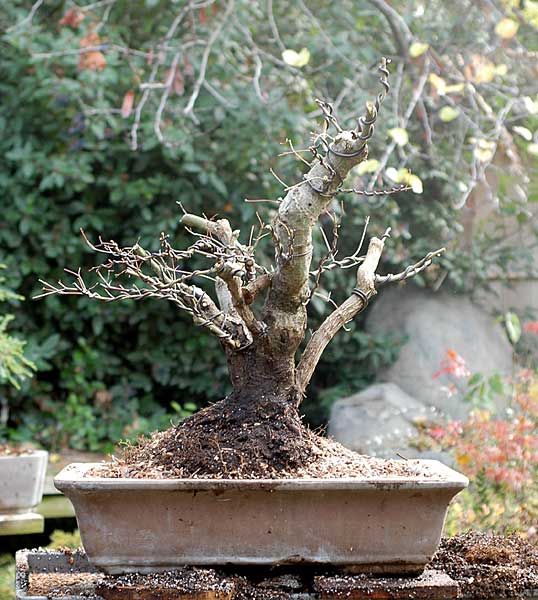
Philippe sent me this to compare to the tree at Kokufu Ten in 1996. Well, it has developed in all these years for sure. One should know that the limbs were much longer when I got it six months ago. I cut back drastically. Now I will develop much finer ramification as it already had in 1996.
It was pointed out to me that a tree that was good enough in 1996 will not necessarily be good enough today to enter. Sure, that's true. And one also has to consider that there is a zenith in the development of every tree. With broadleaved trees this is often after 30 to 50 years. After that they deteriorate. Well, I think this maple has another twenty years to go. Then I will be 86. So for me it's fine.

It was pointed out to me that a tree that was good enough in 1996 will not necessarily be good enough today to enter. Sure, that's true. And one also has to consider that there is a zenith in the development of every tree. With broadleaved trees this is often after 30 to 50 years. After that they deteriorate. Well, I think this maple has another twenty years to go. Then I will be 86. So for me it's fine.

Thursday, January 27, 2011
maple from Kokufu Ten 70
This Japanese maple found the way into my garden in late summer of 2010. When I acquired it I was told that it was on Kokufu Ten 72. Well, some friends searched the Kokufu Ten 72 book and the 71 and the 73 and did not find that tree. So I got the impression that it never was there. But I love this tree by now, have put it into a new pot and started to edit the crown. It has become MY tree in the meanwhile which is close to my heart. Wolfgang was so nice to search for me and found it in Kokufu Ten 70 which took place in 1996. And here we are! Well it is a good feeling. While this tree is not for sale it would certainly help price wise to have prove.


Worthless discussion about bonsai styles?
Worthless discussion about bonsai styles?
A few years ago I had the pleasure to interview Kimura. among other things I asked him 'you have started what now has become modern bonsai style. How and why did this happen?'.He answered along the lines 'I have started nothing, I always did and do traditional bonsai'. He apparently was not ready to comment further on this subject.
Ryan Neil, who has studied under Kimura for 6 years a very recently said something along these lines: 'In Japan the subject bonsai styles (in the sense of movements is not discussed all. They just do bonsai. They don't discuss whether bonsai is an art form or not.' Ryan, while quite open about any subject, seemed to not want to speak about bonsai styles either. Boon, one of the present stars in American bonsai is quoted ons saying on many occasions 'this discussion about bonsai styles is totally superfluous and counterproductive. There are no bonsai 'styles', there are only good bonsai or bad bonsai.'
So one can conclude that at least three very important people in the bonsai world are going into the same direction about this issue. Their verdict must be authoritative. Well, I am sure one could find several dozen more important bonsai people who are of similar opinion. When this subject comes up on the internet there are always a few rather heavyweights who try to close the discussion by making clear that this is fruitless. While some of these could be called bonsai fundamentalists it would not be fair at all to say that only bonsai fundamentalists refuse a discussion. It is, however, obvious, that the majority of the nay-sayers are artists themselves, successfully so.
So shall we stop this 'totally superfluous' discussion from now on? Let's recapitulate. Boon said it the best. 'There are only good bonsai or bad bonsai. OK, let's look at other fields: To make differences in styles of music is totally superfluous, there is only good music or bad music. To make differences in styles of food is totally superfluous, there is only good food or bad food. One could go on and find many more most monstrous and outlandish statements like these.
What is my take on this? Why do I discuss this so often? Well, it comes from the fact that over the years I set in my garden and just did bonsai, trying to do good bonsai. I have the great luck to not have to sell what I make. Therefore I can create something that I like and don't have to think about other people's taste. I honestly try very hard to create something that is really good and it takes quite awhile until I myself am impressed about my work. When that is so I often publish the result to share it with others. Almost every time I did so I got hammered by a few. I was asked how I could create such lousy things and call them 'art' - and similar. Every time I was shocked to see a harmless sharing of what I thought was good work end in a battle with all sorts of honest and some evil minded individuals.
This experience I had many times and it made me think hard about bonsai taste. As a result I came up with what by now is the almost legendary 'styles and forms' script. Later on I wrote a lot about these things. All fruitless and worthless? Well, I came to the conclusion, that just as it is very important to differentiate between styles of music and food this is also true about bonsai styles. It is to be able to discuss intelligently, to create a code that is commonly understood, to not have to start every conversation with telling the other one what you mean. It is not enough to call it 'food'. The discussion would make much more sens if I called it 'Italian food - namely spaghetti - original as in Italy'. In bonsai discussions it would make things a lot easier if everybody would know what was meant by 'modern bonsai - Italian dialect'. Well, they don't.
Recently I had this epiphany: The artists are better off if they don't care about this. They just have to do their work. They can rightfully refuse to discuss about this systematization. But the general crowd that discusses bonsai is much better of in developing some code to be able to talk intelligently. So don't listen to the artists, to the heavyweights. They are speaking about their own personal situation where it is OK to not care about such things.

So BTW what is 'modern bonsai - Italian dialect'?
Well here is a famous tree by Enrico Savini. That's what is meant. Why modern and what is a bonsai dialect? Great! Now we can start to discuss intelligently.
Reconocimiento de modelos al juzgar bonsáis - Spanish
Reconocimiento de modelos al juzgar bonsáis - Spanish
Reconocimiento de modelos al juzgar bonsáis, o cómo evolucionan los gustos en bonsái
por Walter Pall
Traducción: Pedro Herrera
(Este artículo se publicó también en Art of Bonsai Project como "eristic")
¿Puedes diferenciar entre una conífera y una frondosa con sólo mirar una imagen?. Por supuesto que puedes, cualquier niño puede hacerlo. ¿Puedes diferenciarlas, incluso cuando la conífera crece más parecido a como lo haría normalmente una frondosa y el árbol frondoso crece como una conífera?. Seguro que sí. Ves esto en una fracción de segundo mirando una imagen.
Bien, ahora explica cómo tomas exactamente la decisión. Algunos tendrán éxito con una buena explicación, a algunos se les ocurrirá una mala explicación y otros ni se molestarán. Pero todos tardarán bastante tiempo en expresar algo que han "sabido" en una fracción de segundo.
Aunque nuestro cerebro sabe cómo hacer esta clasificación, nuestra mente consciente a menudo es incapaz de articular las reglas. Nuestro cerebro está excepcionalmente capacitado para este tipo de tareas. Somos unas máquinas increíbles de reconocimiento de modelos.
Nuestro cerebro ha evolucionado precisamente para hacer esto con gran exactitud. Si tenemos un conjunto de objetos podemos crear reglas internas para clasificarlas. Cuando aprendiste a leer te mostraron muchos ejemplos de la letra "a". Has aprendido a ver la letra "a" tanto si está escrita a mano como impresa. Puedes pronunciar la "a" de forma inmediata, incluso si está escrita con mala letra o impresa en caracteres extraños. Puedes hacer esto incluso aunque nunca hayas visto una determinada caligrafía o fuente de letra. Pero te resultaría difícil explicar en cada caso cómo llegaste a tu conclusión.
Eres muy bueno en la decisión inmediata de que una letra NO es la "a". Por lo tanto, debe haber algún mecanismo que te permite hacer esto para leer textos a una enorme velocidad.
El reconocimiento de objetos abstractos es aún más complejo. Aprendes pronto lo que es bueno y lo que es malo. Te dan muchos ejemplos en tu infancia. A medida que te haces adulto tu cerebro recopila todos los ejemplos de actos buenos y malos y en cierto momento descubres las reglas de cómo tomar decisiones. Cuando te encuentras ante una nueva situación en la vida a la que nunca antes te has enfrentado, puedes aplicar instantáneamente estas normas. Así que todos tenemos normas internas, pero difieren ligeramente según se hayan desarrollado. Así pues, tenemos nociones ligeramente diferentes sobre la moral. Estas diferencias llegan a ser sorprendentes cuando conocemos a una persona que creció en una cultura completamente diferente a la nuestra y que aparentemente aplica reglas radicalmente diferentes para distinguir lo "bueno" de lo "malo".
¿Qué tiene que ver todo esto con los gustos en bonsái?. Bueno, ocurre exactamente lo mismo cuando aprendemos a apreciar los bonsáis. Aprendemos que un árbol que sigue las reglas del bonsái que están escritas en los cánones, es bueno. Cuando se rompe una de estas reglas se convierte en malo. Aprendemos que los árboles diseñados por Naka, Kimura, cualquier gran maestro japonés son buenos. No nos conformamos sólo con que se diga. Aprendemos a buscar imágenes de árboles como modelos. Hemos aprendido a ver "buenas" y "malas" aplicaciones de las reglas. Aprendemos a ver las semejanzas en los árboles que son "buenos" y de alguna manera crear nuestras propias reglas internas de decisión. Después podemos juzgar un árbol que no hayamos visto nunca antes. Podemos decir de inmediato si tenemos un trozo de materia prima o una obra maestra delante de nosotros. No todos somos igual de buenos en esto. Algunos pueden desarrollar mucho esto y convertirse en expertos en juzgar bonsáis. Fíjate que no se ha hablado aquí de CREACIÓN de bonsái. Se trata sólo de juzgar visualmente. Según este concepto, una persona puede ser un juez experto de bonsái sin haber tocado un árbol.
La pregunta ahora es la siguiente: ¿hasta qué punto estamos realmente juzgando el mérito de los bonsáis, y en qué medida estamos simplemente utilizando nuestras habilidades de reconocimiento de modelos?.
Sí, algunos bonsáis tienen la capacidad de conmovernos emocionalmente, transmitir un mensaje, hacernos sentir su "alma". ¿Pero podemos estar seguros de que esta respuesta no es simplemente una reacción aprendida?. Apreciar un bonsái requiere entrenamiento. Generalmente no suele ocurrir que alguien que no tenga formación pueda apreciar y distinguir fácilmente entre "buenos" y "malos" bonsáis. ¿No es posible que lo que llamamos formación artística sea esencialmente formación para la clasificación de modelos?.
Ahora, demos un paso más. Me he instruído para apreciar bonsáis contemporáneos mediante una intensa experiencia, y si mi cerebro está capacitado para ese tipo de cosas, entonces formularé reglas para descubrir lo que me dijeron que era "buen" bonsái y distinguirlo del "malo". Cuando visite una exposición y vea el trabajo de un artista nuevo, aplicaré mis reglas del "buen" y "mal" bonsái y haré mi juicio sobre la calidad de este artista. Puesto que la mayoría de nosotros fuimos adiestrados en los mismos libros y con ejemplos similares de bonsáis "buenos" y "malos", nuestras opiniones frecuentemente serán similares a las de otros bonsaistas, y el nuevo artista será calificado de acuerdo con eso.
Esto se aplica, en el mismo sentido, a los diseñadores de bonsái. Si resulta que llego a ser un maestro de bonsái, juzgaré mi propia obra con las mismas reglas abstractas de lo "bueno" y lo "malo" y produciré bonsáis que pasen mi propio criterio de juicio. Por lo tanto, una vez que se establece que ciertas obras son ejemplos de buen arte, casi queda garantizado que el modelo se perpetuará para futuros artistas y críticos. Esto va tan lejos que un número considerable de expertos y artistas de bonsái creen que sólo hay una manera de hacerlo "correctamente". Hay una fuerte tendencia al fundamentalismo; es algo inherente al sistema de cómo evolucionan los gustos en bonsái.
Existe actualmente en la apreciación de los bonsáis algo más, por supuesto, que este simple reconocimiento de modelos, pero ¿tenemos alguna manera de separar ambos?. Normalmente no existe un observador externo al sistema, y nunca podremos saber en qué medida nuestras preferencias estén sesgadas por la formación de modelos de reconocimiento que hemos recibido en el pasado. Pero recuerda el ejemplo anterior, cuando "sabíamos" exactamente lo que era moralmente bueno o malo y, de repente, una persona de otra cultura tenía un código moral muy diferente. La cuestión es si incluso somos capaces de escuchar a alguien que venga de otra cultura de bonsái. Si le escuchamos, ¿entendemos lo que está diciendo?. Probablemente no, en realidad, y, seguramente querremos permanecer en nuestro cómodo mundo del bonsái, bien establecido y definido, en lugar de cuestionarnos constantemente nuestras ideas. Y no nos damos cuenta de que lo que creemos que son reglas "naturales", simplemente evolucionaron casualmente y se convirtieron en un código de aceptación general. Pero, por azar podría haberse convertido en un código muy diferente.
No podemos llevar a una exposición de bonsái a una persona de la calle que nunca ha visto un bonsái ni la teoría sobre ellos. Bueno, sí podemos, pero ¿qué vamos a esperar?. La persona hará algunos juicios y dará alguna explicación, pero en realidad lo único que nos indicará es que tenemos frente a nosotros a alguien con un gusto muy ingenuo y sin experiencia. La forma artística es también un lenguaje en sí mismo, y sin estar expuesto a ella no se puede aprender ese idioma. Se cuenta la historia de una persona que se acercó a Picasso y le dijo: "Sr. Picasso, no entiendo su arte". Picasso le respondió: "¿sabes chino?". "No". "Pero se puede aprender chino".
¿Alguna vez sabremos, de alguna manera, la verdadera diferencia entre el elitismo perpetuado a través de reconocimiento de modelos y el valor intrínseco de un bonsái?.
Adaptado de: "Arte y elitismo: una forma de reconocimiento de modelos"
por Kunal Sen, 2007, blog Enciclopedia Britannica
Wednesday, January 26, 2011
Development of nursery maples
These are all Japanese maples, Acer palmatum, variety KIOHIME. They come from a very large regular garden tree nursery and were hand picked from a few thousand according to their usability for bonsai. Here one can see how this sort of material gets developed over a couple of years. Actually from outright nursery stuff one can develop a high class bonsai within five to ten years. Prerequisite is that you develop a very good eye to select your starter material. And then you have to learn the craft to deal with these. The fist is quite difficult but crucial, the second is rather easy and everybody should be able to learn it.
Case 1: Dug out of nursery ground in 2005, cut back ruthlessly with hedge pruners and planted into container right away. In November of 2006 WP works on this in a workshop environment to make the major first cuts.


The tree was then left alone and could grow freely. In October of 2008 it was cut back again. This time a bit more care was taken. The cuts went back to two or three buds mostly. In April of 2oo8 the tree was taken out of the plastic container and planted into a bonsai training pot.


In summer of 2009 and 2010 the tree got a serious haircut. All long new shoots were cut back to two or three buds. All superfluous shoots were removed completely. In December of 2010 the maple starts to look pretty good. It can go into a good bonsai pot in spring of 2011.

Case 2: this is from the same source. It was the best of the batch right from the start. Best in terms of impressive nebari and placement of subtrunks and branches. It was also dug out of a tree nursery in 2005, cut back ruthlessly with hedge pruners and planted into a box right away. In November of 2007 WP cut out big subtrunks which were not needed and set the form for the future. The trick here is to cut back much more than you like. The tree will look terrible after this first main styling. But it is crucial for the future development. It is not important what this looks like right now, it only counts what it will look like in five to ten years. let's see.

The tree cold grow freely then and was cut back ruthlessly in fall of 2007 again. In April of 2008 it started to look somewhat decent. The tree was taken out of the box and planted into a reasonable training pot.


In fall of 2009 and 2010 it was cut back ruthlessly again. In December of 2010 now one can see the result of this. Without foliage one can see all detail. Now is the time to do very detailed cuts. So far no wire was used. It was not necessary in this case, but one can well use wire as needed. Jim Doyle shows how he refines the tree during a demonstration. It is visible by now that this will be a great impressive bonsai in a few years. It could go into a good bonsai pot in spring of 2011 already.


Here one ca see some more of these maples. At Nature's Way Nursery in Harrisburg, Pa one can take part in workshops with this kind of material. They come as outright raw material or already after first styling.


Case 1: Dug out of nursery ground in 2005, cut back ruthlessly with hedge pruners and planted into container right away. In November of 2006 WP works on this in a workshop environment to make the major first cuts.
The tree was then left alone and could grow freely. In October of 2008 it was cut back again. This time a bit more care was taken. The cuts went back to two or three buds mostly. In April of 2oo8 the tree was taken out of the plastic container and planted into a bonsai training pot.
In summer of 2009 and 2010 the tree got a serious haircut. All long new shoots were cut back to two or three buds. All superfluous shoots were removed completely. In December of 2010 the maple starts to look pretty good. It can go into a good bonsai pot in spring of 2011.
Case 2: this is from the same source. It was the best of the batch right from the start. Best in terms of impressive nebari and placement of subtrunks and branches. It was also dug out of a tree nursery in 2005, cut back ruthlessly with hedge pruners and planted into a box right away. In November of 2007 WP cut out big subtrunks which were not needed and set the form for the future. The trick here is to cut back much more than you like. The tree will look terrible after this first main styling. But it is crucial for the future development. It is not important what this looks like right now, it only counts what it will look like in five to ten years. let's see.
The tree cold grow freely then and was cut back ruthlessly in fall of 2007 again. In April of 2008 it started to look somewhat decent. The tree was taken out of the box and planted into a reasonable training pot.
In fall of 2009 and 2010 it was cut back ruthlessly again. In December of 2010 now one can see the result of this. Without foliage one can see all detail. Now is the time to do very detailed cuts. So far no wire was used. It was not necessary in this case, but one can well use wire as needed. Jim Doyle shows how he refines the tree during a demonstration. It is visible by now that this will be a great impressive bonsai in a few years. It could go into a good bonsai pot in spring of 2011 already.
Here one ca see some more of these maples. At Nature's Way Nursery in Harrisburg, Pa one can take part in workshops with this kind of material. They come as outright raw material or already after first styling.
Tuesday, January 25, 2011
Rohlinge für grössere Bonsai aus der Baumschule - German
Rohlinge für grössere Bonsai aus der Baumschule - von Walter Pall
geschrieben 2006
von Achim editiert am 11.01.2008
Jeder Bonsaifreund möchte einen tollen Ahorn. Den kann man kaufen. Aber die meisten wollen ihn am liebsten selber machen, aus Rohmaterial. Rohmaterial für japanische Ahorne gibt es in jeder vernünftigen Baumschule. Aber es gibt doch keines, aus dem man einen Weltklassebonsai machen kann. Es gibt doch nicht einmal Ahorne in Baumschulen, aus denen ein halbwegs begabter Bonsaifreund in wenigenJahren einen Baum der Europaklasse machen kann. Was man so bekommt ist doch nichts im Vergleich zu importierten Rohlingen, die schon viele Jahrzehnte als Bonsai vorbereitet wurden; aber auch einiges kosten.
STIMMT SO NICHT!
Mein Freund John Roehl aus Fresno, Kalifornien war total begeistert von meinem grossen Ahorn und wollte unbedingt auch so einen - selber machen. Und dann noch in seinem Alter!??
Na ja, mal sehen!
Denn gehen wir halt einen suchen.
Nördlich von Sacramento, Kalifornien liegt eine bekannte Baumschule in einem stillen Tal in den Vorbergen. Evergreen Gardenworks http://www.evergreengardenworks.com/
wird von Brent Walston geleitet, dem führenden Fachmann für Bonsaigärtnerei. Er hat da so an die zehntausend Bäume. Sie sind alle aus Samen oder Stecklingen gezogen. Die meisten grossen sind nicht für Bonsai gedacht, sondern für Landschaftsgärtnei.
John möche einen Bonsai, der so zwischen 60 und 80 cm gross ist.
Also sucht er mit seinem Freund Howard in der Abteilung, wo die Dinger stehn, die so etwa 50 bis 100 cm hoch sind.

FALSCH!
Wer einen Bonsai will, der zwischen 50 und 80 cm hoch sein soll, der sucht bei Bäumen, die von 100 bis 250 cm hoch sind!
Der Laie meint, dass eine grosser Bonsai entsteht, indem man mit einem kleinen anfängt und ihn viele Jahre lang pflegt, bis er gross ist. Tatsächlich entsteht ein grosser Bonsai aus einem Baum, der viel grösser ist und kleiner gemacht wird. Viel kleiner als man so denkt!
Also in der Abteilung wo die Bäume höher als zwei Meter sind. Gut, aber wie auswählen?

Man sieht NUR auf den unteren Teil, der bis 50 cm über dem Boden ist! Alles darüber interessiert überhaupt nicht!
Man beurteilt die Stammverjüngung, die Stammbewegung. Wenn mehrere Stämme da sind, dann sollten sie irgendwie zusammenspielen.
Ideal wäre es jetzt, auch noch den Wurzelansatz zu sehen. Auf keinen Fall sollte der Baum eine Propfstelle aufwiesen. Dass kann nix werden, Nicht in hundert Jahren!
Also gräbt man mit den Fingern und ev. mit einem Werkzeug in das Oberflächensubstrat bis man eine Vorstellung von den Wurzeln hat.
In diesem Stadium kann man kaum kritisch genug sein. Jetzt nur ja nicht Zeit sparen. John hat mehr als vier Stunden herumgesucht bis er seinen Kandidaten gefunden hat. Vier Stunden!? Wozu der Aufwand?
Nun, wenn das in den nächsten Jahrzehnten ein Klassebaum werden soll,dann wird sich John in Zukunft so einige hundert Stunden damit beschäftigen müssen. Da ist es soch unheimlich wichtig, dass er mit dem allerbesten verfügbaren Material anfängt. Auch wenn es ein paar Stunden dauert, bis er es gefunden hat.
Zu viele Bonsailiebhaber beschäftigen sich zu lange mit durchschnittlichem Material, das sie in relativ kurzer Zeit gefunden haben, anstatt viel länger zu suchen und nur mit dem Besten vorlieb zu nehmen.
Aber was ist das Beste? Ein Anfänger hat es schwer,das zu beurteiln. Noch schlimmer, auch Fortgeschrittene und sogar sehr Fortgeschrittene würden NICHT den richtigen Baum finden.
Das ist der Sinn dieser Serie hier, das zu zeigen.
Jetzt ja nicht Geld sparen wollen. Da sind drei Bäume in der engeren Wahl. Sie kosten 150, 300 und 400 Dollar. Wer jetzt den billigsten nimmt, ist wirklich selber schuld. John nahm den für 400. Was soll das jetzt, 100 Dollar sparen? Er wird sich einige hundert bis tausend Stunden mit dem Baum in Zukunft beschäftigen. Wenn die Stunde 30 Dollar wert ist, dann ist die zukünftige Arbeit von 5.000 bis 20.000 Dollar wert!!!
Also das ist er jetzt. John meint, dass er mit einem kleinen Lastwagen wiederkommen sollte. Nix da! Der wird auf der Stelle kleiner gemacht.

Mit einer grossen Heckenschere wird der Baum bis auf eine Höhe von etwa 60 cm gekürzt. Dann werden gleich noch solche Äste herausgeschnitten, die ganz sicher nicht zur Gestaltung gehören.
Man lässt Stumpen stehen, die dann NICHT versorgt werden. Also nix draufschmieren!

Zu Hause angekommen sind Entscheidungen zu treffen. Lässt man den Baum erst einmal eine Vegetationsperiode stehen oder beginnt man sofort mit der Gestaltung?
Es wäre das Beste, den Baum jetzt so stehen zu lassen und ein Jahr später nach dem kräftigen Neuaustrieb daran weiter zu arbeiten.
Aber John hat genau so wenig Geduld wie alle anderen Bonsaigestalter. Es ist ein Gerücht, dass Bonsai für geduldige Leute ist.
Also überlegt er noch, ob der Spätherbst die richtige Jahreszeit für´s Gestalten ist. Bei ihm in Fresno ja. Da ist es so wie in Sizilien. Im Sommer brütend heiss und im Winter kaum jemals Frost. Bei uns wäre das sicher nicht die richtige Jahrezeit. Bei uns müsste man auf jeden Fall bis so etwa Ende März bis Mitte April warten.
Jetzt muss der Stammansatz herausgearbeitet werden.
Dazu muss der Baum aus dem Plastikeimer. Voraussetzung ist, dass der Wurzelballen dicht ist. Das Oberflächensubstrat wird sorgfältig entfernt. Alle kleinen Wurzeln, die nach oben stehen und die nicht gut ausehen werden sofort abgeschnitten.

Jetzt kommt ein ganz wichtiger Abschnitt: Die allermeisten Bonsailiebhaber schneiden jetzt die Krone soweit zurück, wie sie sich die spätere ideale Kronensilhouette vorstellen. Das kann dann recht vielversprechend aussehen. ES IST ABER LAIENHAFT! Ein Profi stellt sich jetzt die ideale Silhouette des zukünftigen Meisterwerkes vor uns schneidet dann bis zur Hälfte davon weg!
Noch einmal: Wenn der zukünftige Durchmesser der Krone 70 cm sein soll, dann wird auf einen momentanen Durchmesser von etwa 30 bis 40 cm zurückgeschnitten. Wenn die zukünftige Höhe des Bonsai etwa 70 cm aufweisen soll, dann wird auf eine momentane Höhe von 30 bis 40 cm zurückgeschnitten. Der Baum sieht dann deutlich schlimmer aus als vorher!
Wenn die Frau das Ergebnis sieht, soll sie sagen ´Das ist ja entsetzlich, vorher sah er viel schöner aus, du hast ihn ruiniert, jetzt sieht er wie ein schlimmer Besen aus´. Dann ist es genau richtig.
Also nochmal: Das ist der häufigste Fehler von Amateurern. Sie schneiden in diesem Stadium nicht genügend weit zurück! Dann arbeiten sie zehn Jahre an ihrem Baum und bringen ihn zu einer Baumbesprechung. Dann erkläre ich ihnen, dass sie den Baum jezt drastisch einkürzen sollen, weil die Krone viel zu breit und hoch ist. Sie sollen die ganze Arbeit von zehn Jahren einfach abschneiden! Ich erkläre ihnen, dass sie das schon vor zehn Jahren hätten machen sollen. Wehgeschrei!
Warum? Weil der Baum durch Zuwachs und Abschneiden weiter entwickelt wird. Der Zuwachs wird dann jeweils so etwa 10 bis 30 Zentimeter betragen. Er wird zurückgeschnitten, bis auf ein bis drei Internodien. Dann kommt im gleichen Jahr noch einmal Zuwachs, der wieder zurückgeschnitten wird. Das geht so zehn Jahre lang. Jedes Jahr wird die Krone so 1 bis 2 cm breiter und höher, weil ja ein bis drei Internodien stehen bleiben. Wenn man mit einem Kronendurchmesser von 70 cm angefangen hat, dann wird der nach zehn Jahren 90 cm oder mehr sein. Die Höhe wird dann statt 70 ebenfalls so ewa 90 cm sein. Aber man wollte ja einen Baum, der nur 70 cm Höhe und Breite hat! Genau! Deshalb muss man auf 30 cm zurückschneiden und sich dann langsam an die ideale Silhouette vortasten. Also los...


Jetzt sollte man den Baum wieder in den Plastikeimer zurückstellen und mindestens eine Vegetationsperiode warten.
Aber Bonsailiebhaber sind nun mal ungeduldig.
Wenn der Baum wirklich gesund war und die weitere gute Pflege gesichert ist, kann man evtl. auch gleich den Wurzelballen verkleinern und den Baum in eine Entwicklungsschale stellen.
Wenn der Baum wirklich gesund war und die weitere gute Pflege gesichert ist, kann man evtl. auch gleich den Wurzelballen verkleinern und den Baum in eine Entwicklungsschale stellen.
Der Hauptstamm und die Substämme sind dick genug. Was fehlt ist nur mehr eine feine Krone. Die wird in der Schale feiner als in einem grossen Kübel.
Das sieht ja gar nicht nach einem Weltklassebonsai aus ?!
Für den Amateur nicht, für mich schon.

Der Baum kann in zehn Jahren in jeder grossen Austellung neben importierten Ahornen bestehen.
Es gibt Material für Weltklassebäume in Baumschulen.
Subscribe to:
Posts (Atom)