Walter Pall's main blog about bonsai and his work with trees from day to day. Lots of good pictures of good trees and lots of valuable information about bonsai.
Walter,
this is a special find. This group is especially fantastic. I'm
surprised by the amount of material you are acquiring from Japan
recently. Is there a specific reason for this? Or is this just a case
of coming across world class trees and getting them while available?
As usual, I'm filled with envy.
Regards,
Brian
Brian,
What
is happiness? Among numerous answers I always found this one
good:
happiness is a child's dream coming true. A child's dream?
Well, as probably every person who started to get interested in
bonsai I looked at the then available books and magazines thirty
years ago. There I saw all these incredibly beautiful and impressive
Japanese trees and could not believe that this was for real. Oh how
much did I wish to own a tree that came close to these. This was
impossible for several reasons: The trees were not available, they
were in collections and not for sale; if they ever were for sale they
cost as much as a good car or more. And then came the problems of
importing. Later on I learned together with many to work with
indigenous trees and have some hope of creating trees of the quality
we once thought was unattainable to us.
So why the surge
or Asian trees again now? A few tings have changed. First these trees
are now available as many collections are on the market. These trees
are still expensive, but much more affordable then they were. At the
moment a killer tree from Asia costs as much or even less than a
European killer tree.
And then for me personally some
things have changed: When I was closer to death than to life four
months ago I fond that my time is more limited than I wanted to
believe. I simply cannot continue to start with outstanding European
material and try to create masterpieces. in our climate this takes
twenty years usually. I don't have that time. If I get a tree that
already is a masterpiece or was a masterpiece and is only neglected
then I can let this tree shine within a very short period again.
While I would love to get very good already established affordable
European trees they are hardly available. They simply are in
collections and not for sale or unaffordable. So I can fulfill my old
dream because it's possible to have these Japanese trees now which
were unattainable. This does not mean that I give up working on
European material. I just do this in parallel now.
Japanese white pine, Pinus parviflora, collected in Japan and imported into Europe recently. This tree has great deadwood. It was styled a long tiem ago alredady. It will be great fun to refurbish it.
Japanese white pine, Pinus parviflora., imported from Japan. This is a very nice collected tree which was already styled a long time ago. Now it's a bit neglected, but it will be possible to let is shine again in short time. This will be great fun.
Japanese white pine, Pinus parviflira, imported from Japan. This tree was on Kokufu Ten already If someone can find out when and which number exhibit this was I would be grateful. This information I need for history file. Anyway, I am quite happy to have acquired for myself a lot of work. It will be a real challenge to try get this tree into top shape. Well, it is in top shape. So the challenge is to make it even better, if possible much better. We will see and I will report.
Trident maple, Acer burgerianum. It will be great fun to develop this great material. Obviously it needs a good pot. Well, I think in six years it will be presentable. I will report progress, of course. I am very hapy with this catch.
Ezo spruce, Picea jezoensis, collected in Japan about 70 years ago, very old. It was probably collected before the war on the Kuril Islands which used to be part of Japan. It was made a very high, slim bonsai possibly even before the war.
Eventually this tree was exported to Germany many years ago. The owner managed to ruin the tree by loosing the very top. The tree was twice as high as it is now. Someone who did not think too much cut off the dead top instead of making it deadwood.
Anyway now it was a ruin, an ugly ruin for most tastes. This was the only tree that interested me out of way over one thousand very good offers at Bonsaipark Remscheid in the north of Germany last weekend. Why would I pay quite a lot of money for such an ugly tree? Well, it appeals to me very much. While it is ugly it has a real lot of character. It has the character of a very very old tree from the island. And it is a great challenge to bring out that character to its very best. Very old genuine edo spuce colected on the islands are invaluble. They cost a lot of money in Japan and most one is not allowed to export anyway. Well, this one did cost considerably money as ruin, but I got it in trade and I am very happy to own such a rare tree.
Only two months after I got the tree and did the first styling it has changed dramatically. The spruce really likes my feeding and watering regime. It looked as well as it ever could look finally. So I decided to do the final styling much earlier than I had thought originally. Anyway, now the wire will stay on for four to five years and then it should be presentalbe afterwards.
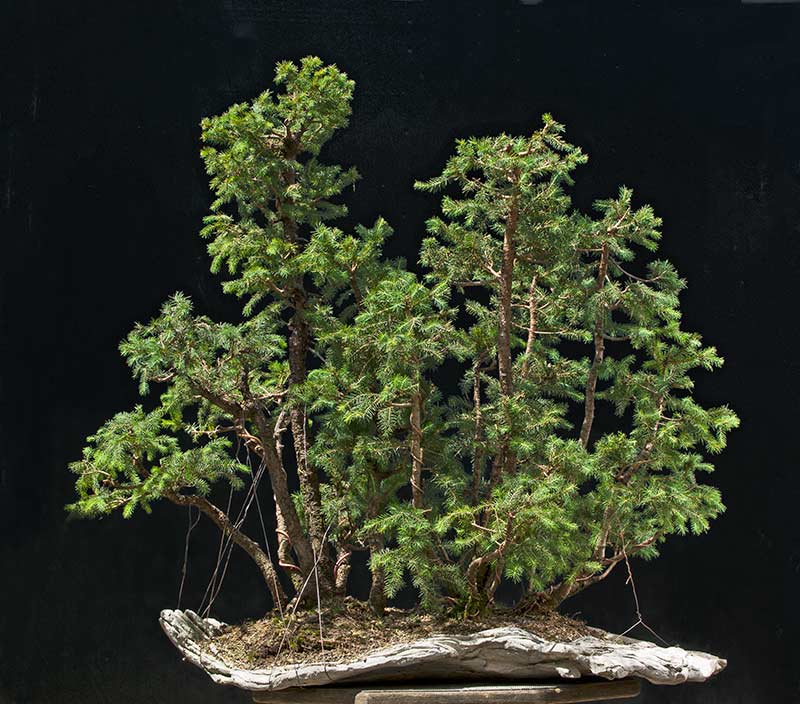
The story started in 2008. Five years later the group looks quite promising. The secret is the quality of material. Instead of using second rate young material for the group I selected very old trees with lots of character. And in the end it shows. The wire will stay on four to five years in my climate. Then the group should be presentable.