See here (German only).
http://www.italpollina.de/Bonsaidunger.asp
Wednesday, March 7, 2012
Monday, March 5, 2012
Interview with magazine in Hong Kong
I was asked for an interview by the Hong Kong based magazine 'Trends'on' http://trendson.com/
Here my answers:
1. What is BONSAI to you?
Bonsai in general for me is an art form, a way to express oneself with the medium of a living tree. For me personally bonsai is my life, my passion, the most important thing.
2. How did you get involved with BONSAI?
In 1978 I saw my first bonsai in a garden center after having read about it. It immediately intrigued me. I was always keenly interested in gardening, nature and in arts. I saw the connection and knew instantly that this was for me. It seemed so impossible, so difficult that I desperately wanted to master it.
3. Please describe your work and what information are you trying to pass on?
My work consists in taking whatever tree I can get my hand on and bring it further step by step. Further means towards the aim of getting it from a stick in a pot to a piece of art, a tree that speaks, a tree with character,a tree with soul.
4. Where do you get your inspirations from? Could you tell us more about the philosophy behind your work?
My inspiration comes form nature, from real trees in my beloved mountains, the Alps. I try to NOT make my tree look like a bonsai, but rather the bonsai like a tree. While form is important it is soul which makes all the difference. I try to concentrate on the soul.
5. What concerns do you have when you decide your executions?
My main concern is to keep the tree alive. Then I want to make the best of it artistically. I try to find what the tree wants to be if it only had the chance. This means not too much impose my own will onto the tree but let it speak to me.
6. What difficulties do you usually run into when working on BONSAI? Or emotions involved? Or most important?
The difficulties are mostly horticultural and artistic. It is very difficult to work hard on a living tree without damaging it but still changing the look radically. Time is the main problem. I look at material closely and develop a clear vision. But then it takes twenty years or even more before that vision comes true. The problem is in the life span of an artist. When he knows very much he is too old to really ever see the result. The most important thing as an artist is to be true, honest, genuine. I do what I think is right, regardless of what the world thinks about me.
7. Do you enjoy the process? Or do you simply focus on the message and outcome?
It is of extreme importance to enjoy the process. Otherwise you will never succeed. It is like in sports or music. If you don't enjoy working out you may have a lot of talent but it is wasted. In an eastern sense the doing is the aim, in a western sense the result is the aim. I simply combine both and I am happy with it.
8. Please tell us about your most joyous and distressed moments!!
The most joyous moments are when after many years smiling at an ugly tree one day it smiles back. You are the only one to see it like the mother sees it on the baby. The most distressed moments clearly are when one of your trees dies. It's like one of your children dies.
9. Have you ever been stopped, or even arrested for your work?
What a strange question. Well there are people who take trees from nature without permit and get stopped or even arrested. I was never one of them. Stopped for doing bonsai, a foreign art form? Nobody in Europe would stop me for doing what I do.
10. What do you think the future of BONSAI is?
I see a bright future for bonsai. More and more people have the problem in a modern world to be separated from nature. Bonsai is a way to get it back. Bonsai is so much more than keeping house plants, it is like having a pet for a life time. It is is growing in Europe and lots of young people are attracted.
11. Which country (ies) do you think has (have) the most developed culture of BONSAI?
In Europe that would be Italy, Spain United Kingdom and Belgium. Japan, of course is still the most developed, but the interest for bonsai is unfortunately not growing there at all. Indonesia seems to be very active. While China has invented the art form it is still kind of sleeping, comparatively. I can see that bonsai could become fashionable there again. I cannot see that China will continue copying Japanese bonsai style like so many other countries. I can see China creating a new genuine Chinese bonsai culture next to the traditional Penjing. I look forward to see it happen within the next ten to twenty years.
12. Please tell us your plan of the next half year.
Working every day for and around bonsai. I will do some traveling, in Europe and I will go to America for ten days to run my International Bonsai Academy there. I will get my hand on as many trees as I can and bring them one step further. I will enjoy myself and be a happy man.

Friday, March 2, 2012
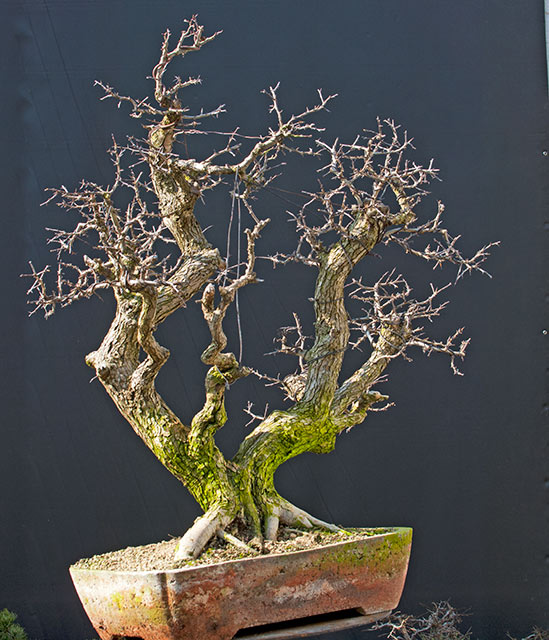
hawthorn #6 coming nicely
European hawthorn, Crataegus monogyna, collected in Croatia in 2008. Exactly one year after first styling the ramification is much better. last image as of April 2009.




oak for sale or trade
This is a historic bonsai. It is a European oak, Quercus robur, collected in Germany in 1981. It was once the best oak bonsai in Germany. I acquired it in 1991. It was featured in a couple of articles. See
http://walter-pall.de/oakseuropean_oak_nr__2.jpg.dir/index.html
Two years ago the tree lost the back branch. I have decided to put the tree up for sale or trade.

http://walter-pall.de/oakseuropean_oak_nr__2.jpg.dir/index.html
Two years ago the tree lost the back branch. I have decided to put the tree up for sale or trade.

Thursday, March 1, 2012
New pot for Prunus #9
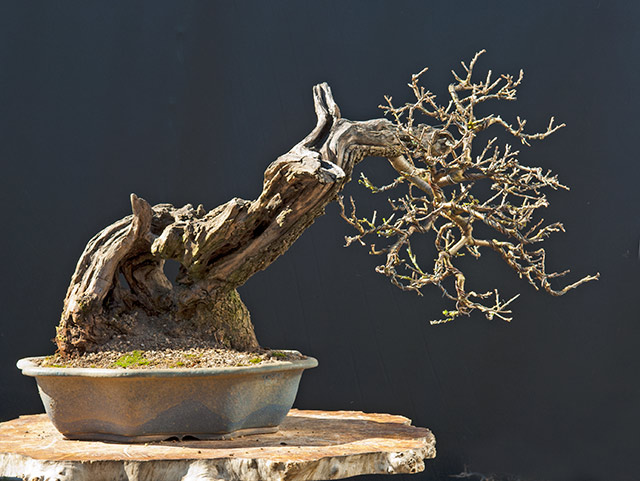
Wild cherry, Prunus mahaleb, collected in France.
the old pot by John Pitt was quite nice, but too small. So I ordered a similar one a bit larger. I think now it's fine. John Pitt did a great job.
Of course this is to the time to repot a prunus. The right time in my climate is beginning to middle of April. But I did slip potting, just moving the intact root ball into a larger pot. This can be done any time.


the old pot by John Pitt was quite nice, but too small. So I ordered a similar one a bit larger. I think now it's fine. John Pitt did a great job.
Of course this is to the time to repot a prunus. The right time in my climate is beginning to middle of April. But I did slip potting, just moving the intact root ball into a larger pot. This can be done any time.


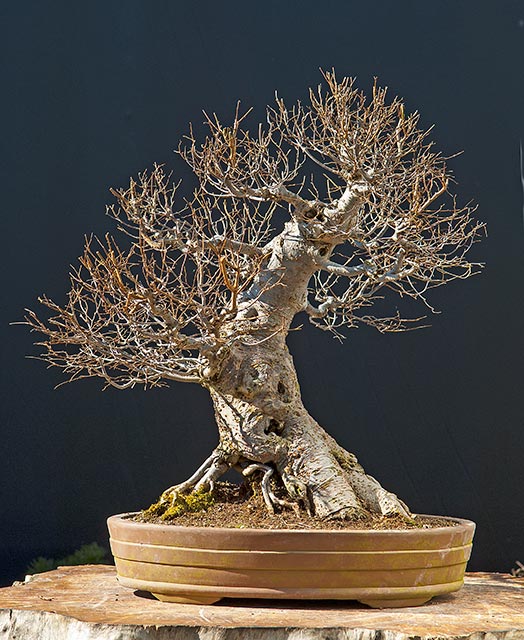


European beech in winter
All European beech, Fagus sylvatica, all collected in the Alps. The last one is for sale or trade.


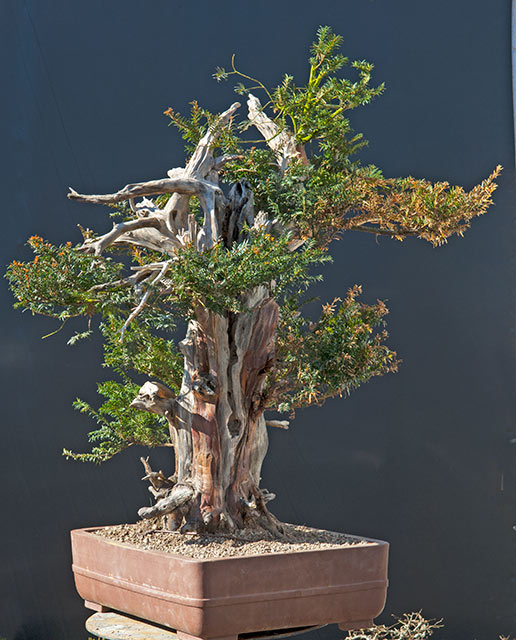
European yew #2 in new pot
In my climate yews should be repotted around end of April. But slip-potting is OK any time. This means just taking the tree with full root ball totally intact and place into a pot without disturbing. Anyway, it worked very well. The explosion last fall was bad when it happened. One can still see some brown branches. But they all have enough new buds. So in the end nothing happened. Now the tree will have to settle for a year. in 2013 it will be styled finally. I will report.




Subscribe to:
Posts (Atom)