Wednesday, July 6, 2011

European spruce # 62

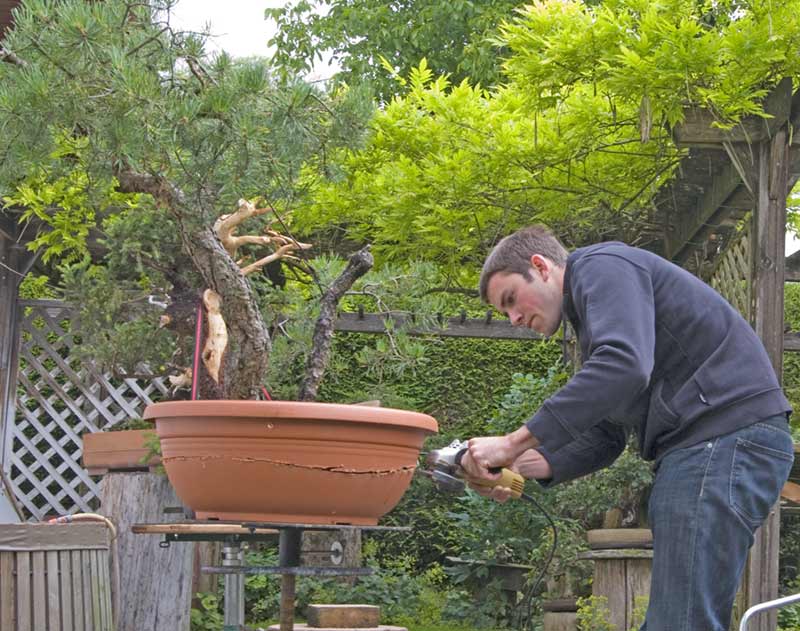
European spruce, Picea abies, collected in Italy in spring of 2009. Very old, probably way over 100 years old. Found my garden in September of 2009. First potted into a reasonable bonsai pot. Then left alone for two years, watered and fed aggressively. In July 2011 it was very healthy and had thick new growth with lots of buds for next year already.
Now the tree was analyzed by Walter and Kolja. The result was approved by WP. Kolja went ahead and did all the deadwood work with some guidance by WP.
The last two images show the future front. The last one is a virtual, of course.
Now the tree will rest for sevral years like this. There has to develop a real lot of green. This will happen by watering and feeding aggressively.
In two to five years then the crown will be styled. I can hardly wait for it.


Monday, July 4, 2011

European spruce #17

European spruce, Picea abies, collected in 2002. Second image as of August 2004.


Sunday, July 3, 2011

Patrick's new Scots pine

Patrick chose this Scots pine (Pinus sylvstris) because he liked the nice trunk movement, good taper, experienced bark and the second trunk. The tree was healthy and as he later found also had a very good nebari. This pine was collected in 2009 in Norway. It was formed by moose in a bog. Scots pines grow boring straight everywhere. But where moose wander through the vegetation like elephants the pines have all sorts of contorted shapes. This one is not all to contorted, but also not boring straight.

At this time or the year it is not a good idea to do too much styling to a pine. They are full of sap and after a long rain branches will snap when you try to bend them. So we went as far a we thought feasible at this pint in time.
On a pine like this one every single little branch will have to be wired and bent eventually. But the old needles should be plucked before that. Since the tree lost a lot of green already it was decided to not weaken it further and wait with the plucking of needles for another four to six weeks.

Future work:
End of July, beginning of August: plucking of old needles
then wring every little branch and start bending.
The bending will not necessarily be done full as one could loose a few branches over winter.
In summer of 2012 more bending will be done and needles will be plucked again.
In April of 2013 th tree will go into a round bonsai pot as shown on the virtual.

Scots pines are not the kind of material that should be styled with abstract crowns which look like Japanese white pines or mugo pines. They will never hold this kind of form and always look kind do untidy. The solution is to style the crown in a rather naturalistic form right away.
This pine looks quite untidy and unfinished at the moment. Well, trees don't have to be finished in one afternoon. We'll see what it will look like in a few years. I hop that Patrick will report.


Saturday, July 2, 2011

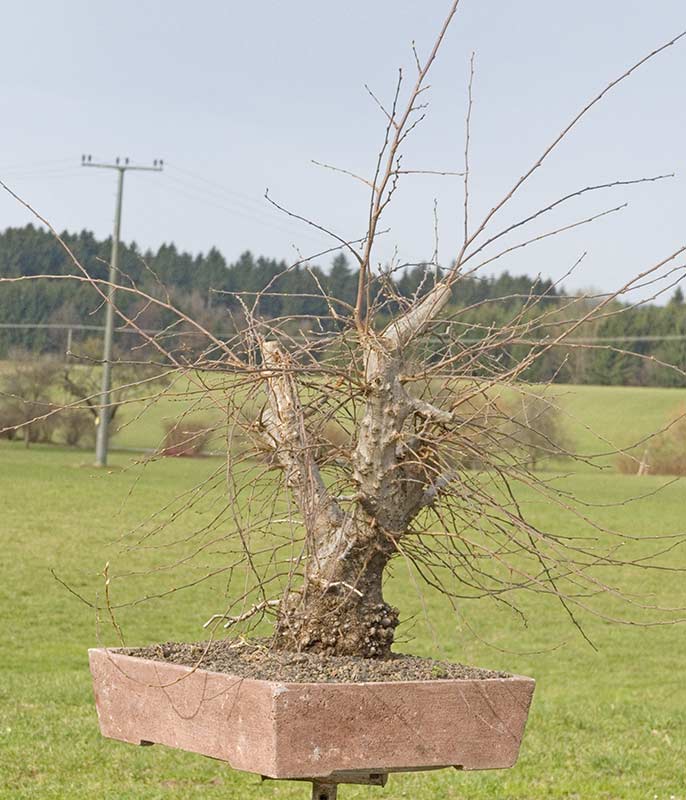
'ugly bumps' on the trunk

Why does this hornbeam have these bumps? Goats have prepared this tree over decades. They eat new growth. Like when you cut a hedge constantly it reacts with lots of new growth. The hornbeam has the habit to throw new growth from the base besides on the top. So the goats could not get into the crown at one point anymore. But they could get underneath go eat the new growth at the base. And so over decades the bumps appeared.

If one thinks that they are ugly you better get another tree, I am afraid. One could cut them off one by one and have a fat trunk with a hundred or so ugly scars which will never disappear.

It would be better to do nothing and just feed and water the tree well. It will grow on the top and over many years due to the lack of goats in my garden the trunk may become more handsome.

Or does it have to? Twenty five years ago I made this photograph of a European (English) oak in the south of England. It has this most unusual sexy trunk. I wanted to see what it would look like in a bonsai pot. I can see amazing similarities to my hornbeam. If someone ever doubted that one can jut go to nature and copy a few details of a real tree and create a naturalistic bonsai - here we are.


Friday, July 1, 2011

oriental hornbeam #15, 11 months later

Oriental hornbeam, Carpinus orientalis, recieved in November of 2010. And 8 months later it looks promising.


oriental hornbeam #17, a year later

Oriental hornbeam, Carpinus betulus, received in Augst of 2010, 11 months later it looks fine.


oriental hornbeam #22, 16 months after collection

Oriental hornbeam, Carpinus orientalis, collected in march 2010. Sixteen months later as of today it has changed a lot. I love this species and this particular tree.